 Irinel IonVIEW PROFILE →
AVALW Studio: The Complete Publishing Infrastructure for Creators, Journalists and Companies
AVALW Studio is not just a place to publish, but a complete media desk placed in the hands of every account from the first article: editor, analytics, monetization, premieres, challenges, badges, rewards and payments. A full tour of the publishing infrastructure for creators, journalists and compani
There is a fundamental difference between a platform that lets you publish text and an infrastructure built to sustain editorial work over the long term. Most services stop at the first level: they give you an editor, a publish button and, at best, a view counter, then leave you alone with everything that is genuinely difficult, from distribution and monetization to audience loyalty and the discipline of turning an occasional activity into a consistent one. AVALW Studio starts from the opposite premise. It puts into the hands of every account, from the very first article, the set of tools that normally only an organized newsroom possesses, and this holds equally true for an independent creator just starting out, for a journalist with an established career, and for a company building its own communication channel without depending on other people's platforms.

A full media desk, from day one
The structure of the panel reflects this philosophy directly. The sidebar groups, in a logical order that follows the natural stages of editorial work, every section an account needs: Dashboard, Stories, Write, Premiere, Contribute, Statistics, Weekly Report, Earnings, Badges, Perks, Tips, Rewards, Payments and Invite. This is not the cluttered menu of a blog, but the complete map of a media desk, designed so that the path from publishing your first piece to the recognition accumulated over years is visible at a glance. Each section covers a real stage in the life of an account, whether it belongs to an individual or an organization, and the overall logic remains constant: first you create, then you build your audience, then you monetize it, and finally you consolidate your reputation and your career.
First you create, then you build your audience, then you monetize it, and finally you consolidate your reputation and your career.
The Dashboard
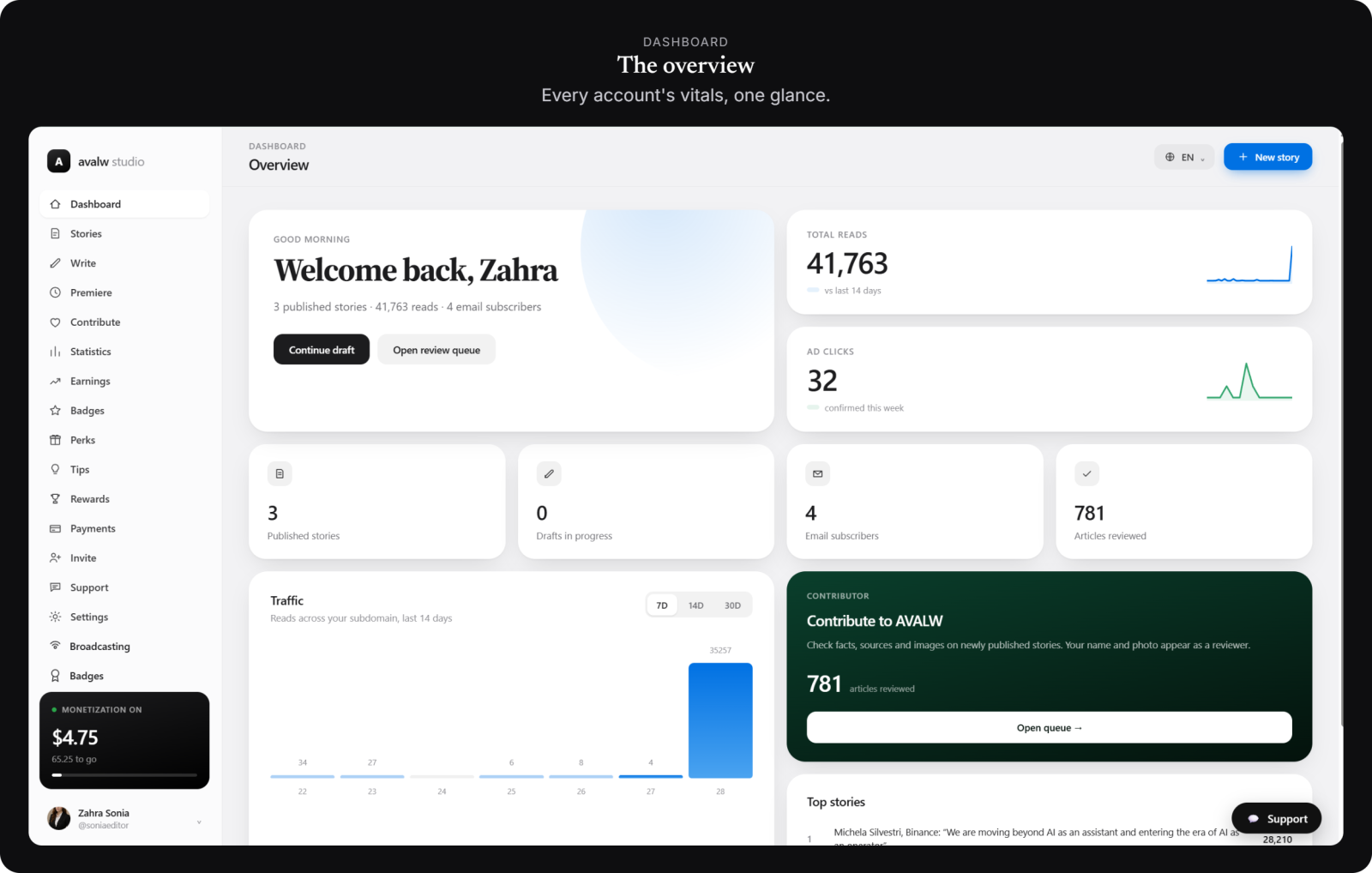
The Dashboard offers, at a single glance, the essential indicators of the account, precisely the figures that describe the true state of an editorial presence: the number of readers gathered, confirmed ad clicks, published articles and email subscribers. The choice to display only these four values in the foreground is not a simplification but a decision about clarity; instead of a wall of distracting charts, the user immediately sees what matters. Below these indicators is the evolution of traffic over seven, fourteen and thirty days, simple enough to grasp the trend at a glance yet precise enough to support decisions. Here too is the list of best-performing pieces, a practical tool for identifying one's own pattern: which subjects, angles and headlines resonate with the audience, so that the next pieces start from what has already worked rather than from guesswork.
The editor
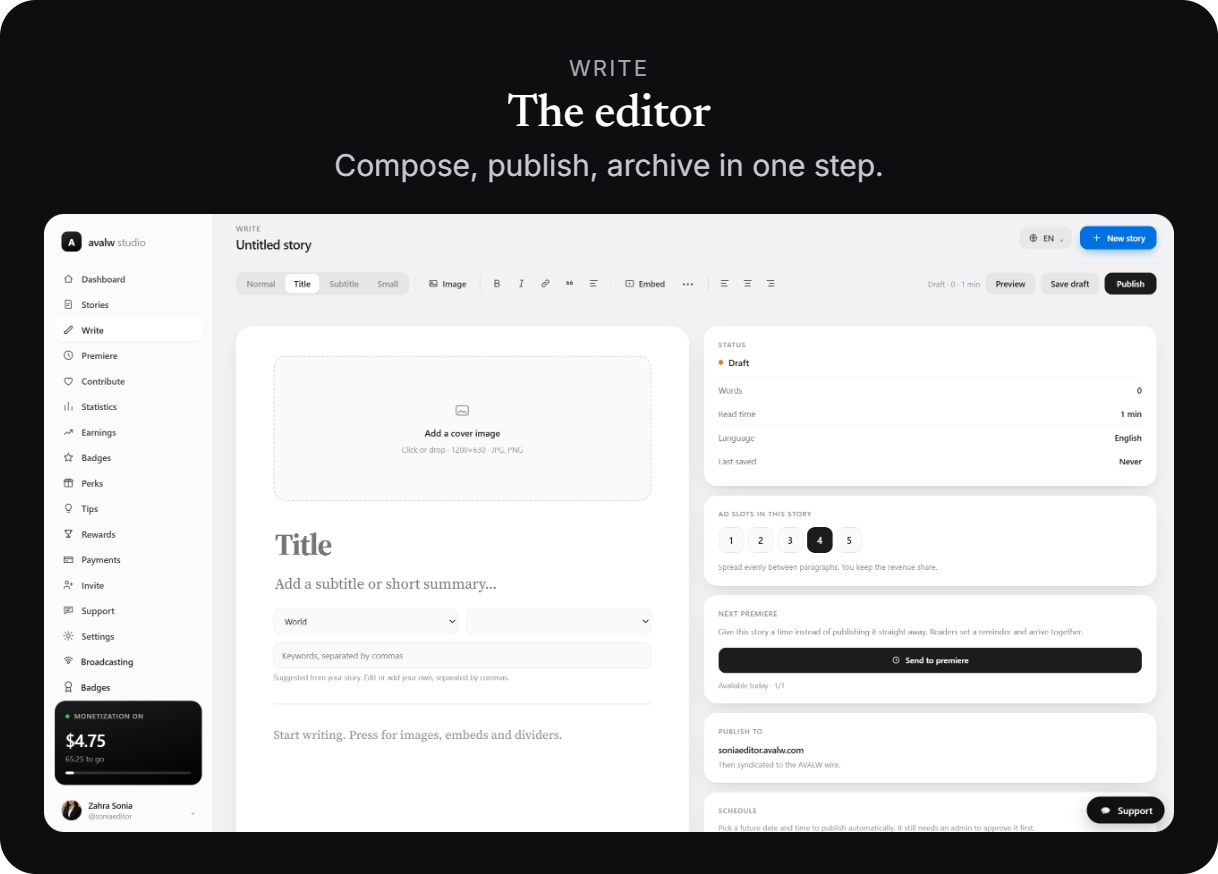
The writing section is the integrated editor, fully functional inside the panel, with no need for any external tool. From here you compose the title, the introduction, the body of the article, the cover image uploaded directly by the user, the category and the language, and publishing takes a single step. Published pieces are then grouped in a dedicated list that works as a living archive of all activity. For a creator, this archive becomes, in time, their portfolio; for a journalist, the body of work they can show at any moment; and for a company, a structured, searchable record of all its public communication.
Statistics
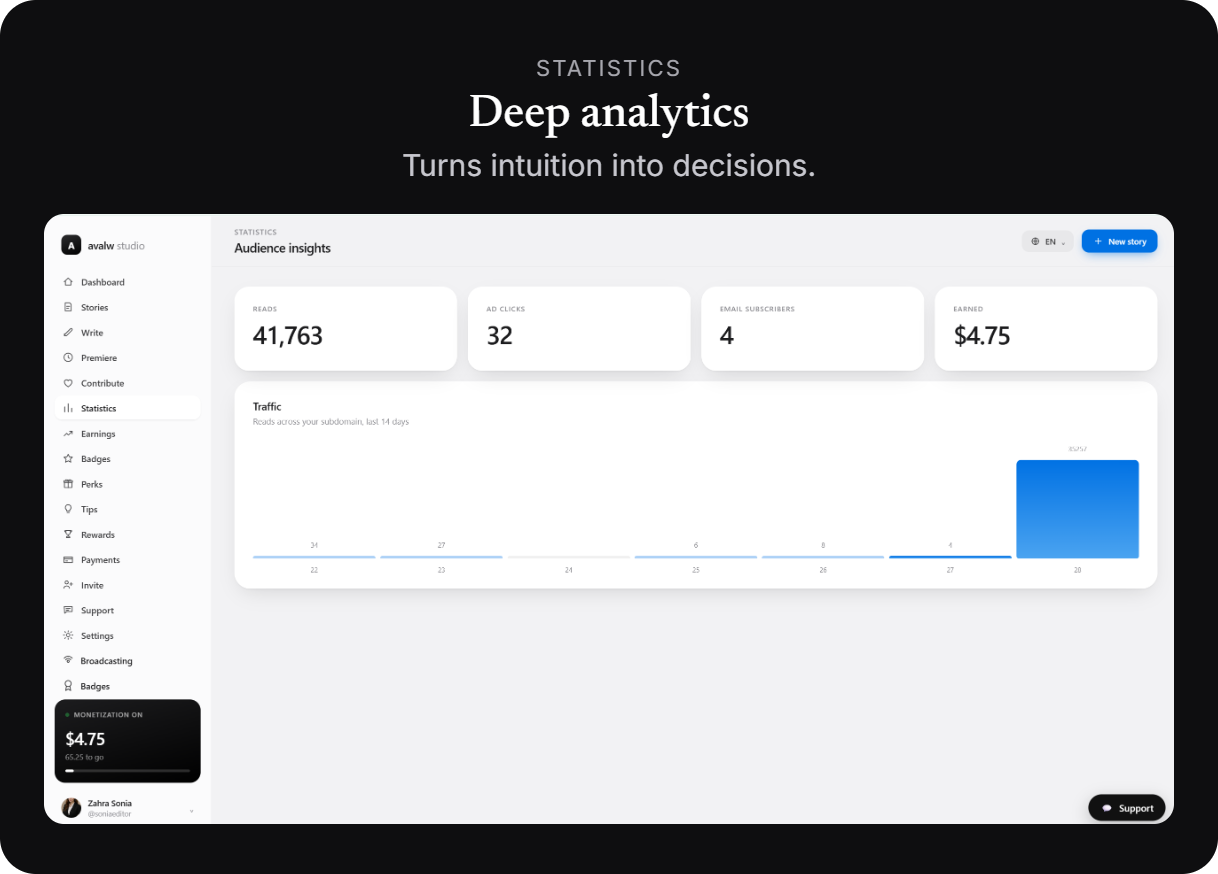
If the Dashboard offers the overview, the statistics section allows analysis in depth. Here one can follow the evolution of the audience over time, the sources from which traffic comes, and how readers behave on each individual piece, from how much they read to what brings them back. This data turns intuition into informed decision: instead of assumptions about what should be published, the user works on the basis of what has already produced results, gradually defining a niche and a loyal audience. A clear niche, even with a smaller audience, is worth more than a large audience without direction, and for an organization the same data becomes a direct instrument for measuring the impact of its communication.
A clear niche, even with a smaller audience, is worth more than a large audience without direction.
The weekly report
To the in-depth analysis of the statistics section is added a component designed for rhythm and discipline: the weekly report. Every Friday, the account receives a complete summary of the week just ended, from Friday to Friday, presented in clear cards and a chart of readers across the seven days. Gathered in a single place are the figures that truly matter for a week of work: the number of readers gained and the change from the previous week expressed as a percentage, ad earnings and balance, the articles published in that interval, new subscribers and the best-performing piece. Each report also shows the date of the next edition, turning Friday into a fixed moment of reckoning. Moreover, the entire report can be downloaded as a PDF document, ready to archive or present, and a copy arrives automatically by email, so that the week's summary comes to the user rather than the other way around. For a creator, this is the rhythm that sustains consistency; for a journalist, a clear record of impact; and for a company, a ready-made communication report, every single week.
Earnings
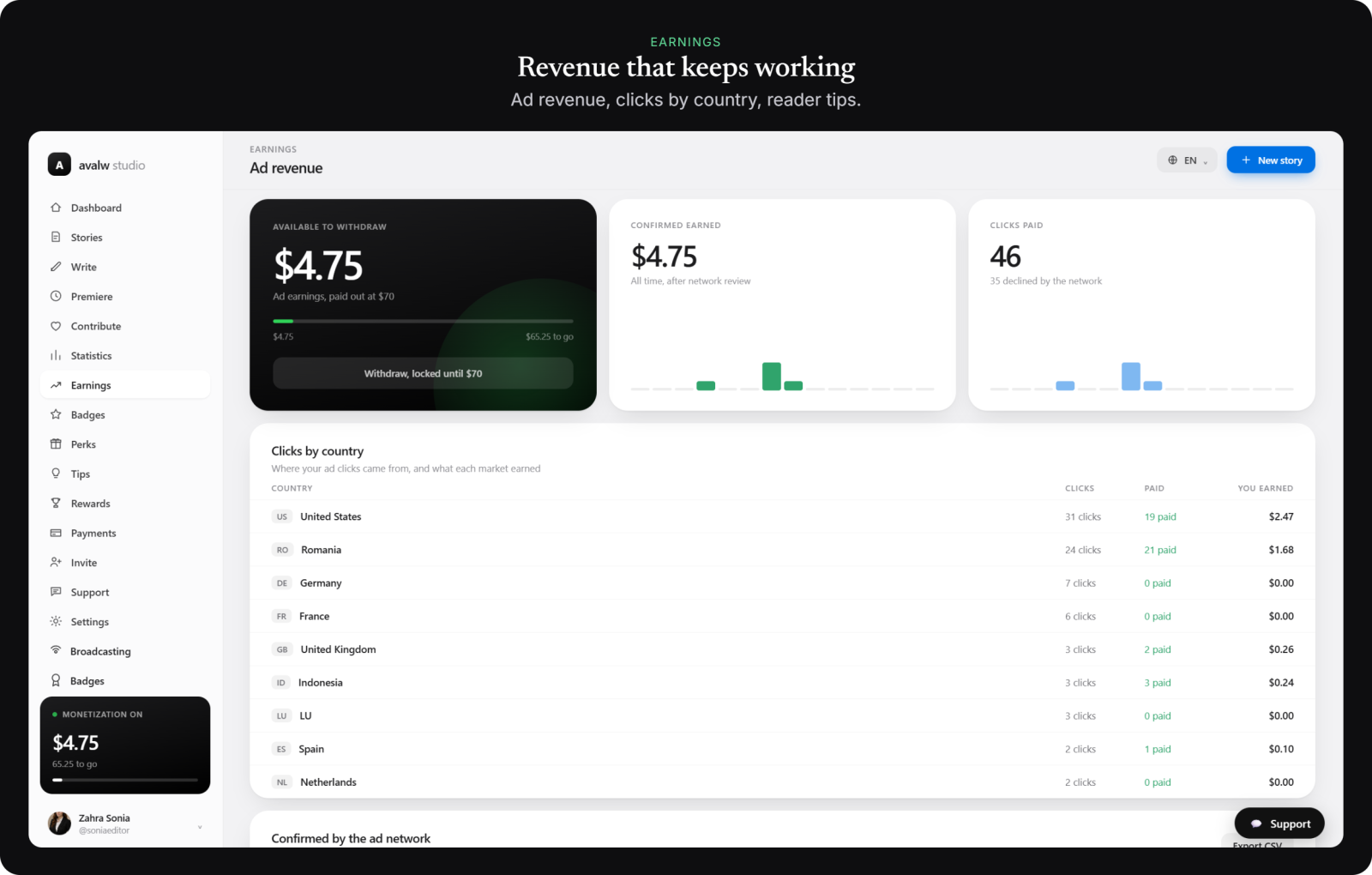
The earnings section presents the financial component transparently, directly in the panel, without hiding it in reports that are hard to read. Accumulated revenue, ad clicks and their geographic distribution by country are all visible, so the user understands exactly which regions the value they generate comes from. An essential aspect of the model is the passive nature of monetization: once activated, it continues to produce revenue for every article long after the moment of publication, as readers reach the piece through search and organic distribution, which means that every text written today keeps working months later.
Reader tips
To this mechanism is added a second source of revenue, designed specifically so as not to raise barriers for the audience. Readers can voluntarily offer a modest amount for an article that impressed them, in preset tiers of a few dollars. This is not a mandatory subscription and not a paywall blocking access to content, but a form of direct support given on one's own initiative. The panel shows how many readers contributed, what proportion of the audience they represent, the average value of that support and the largest amount received, alongside the messages people leave. The difference from the classic subscription model is profound: the audience is not charged at the door but invited to reward work it has already appreciated, which entirely changes the relationship between author and reader.
Premiere
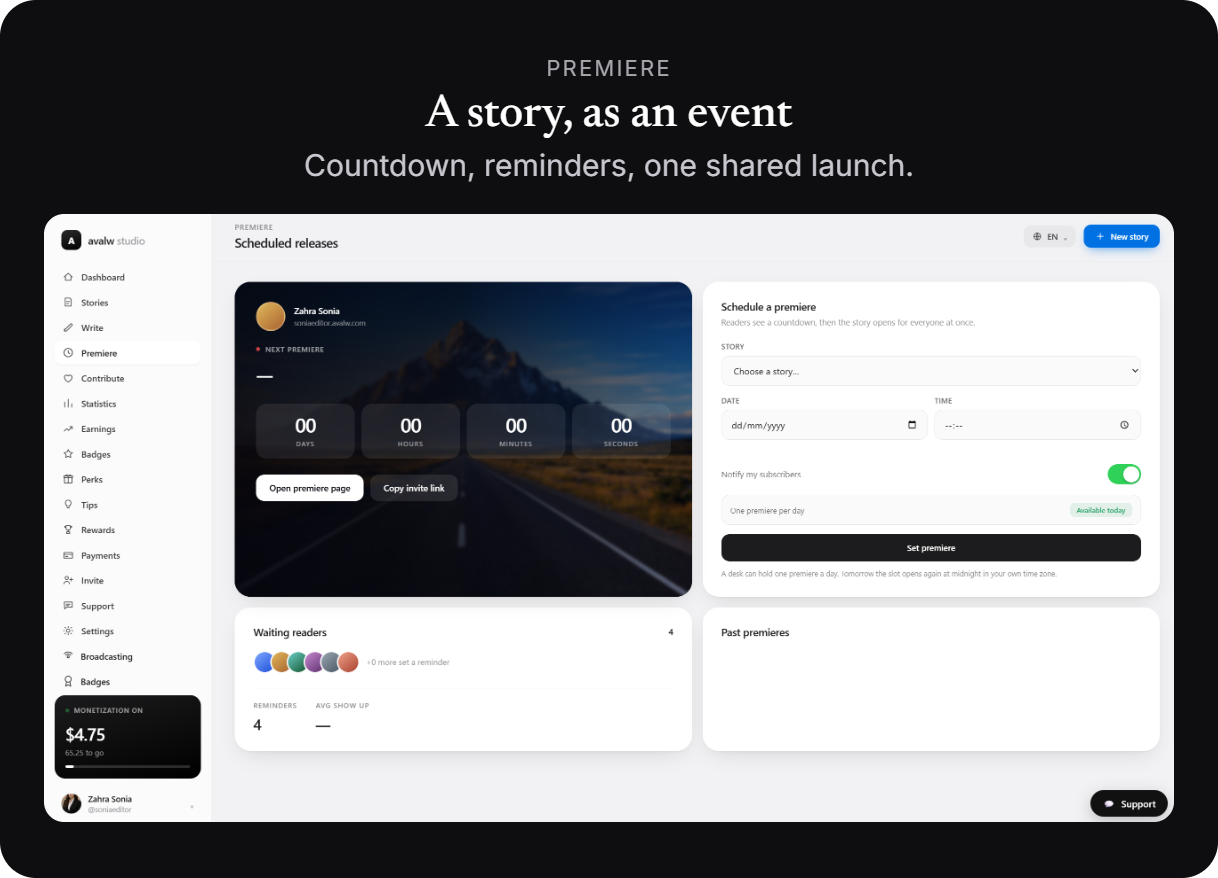
The premiere system is one of the platform's most distinctive components and probably the one with no equivalent at the level of an individual account on ordinary services. It allows an important piece to be transformed from a simple publication into an event scheduled with a fixed date and time, exactly like the launch of a film or a product. Readers arrive on a premiere page that displays a live countdown, can reserve their attendance through a reminder button, and receive a notification at the exact moment the piece becomes available, simultaneously, to the entire audience. The author can notify subscribers and share an invitation link, tracking in real time the number of people who have set the reminder.
The data component completes and supports this mechanism. A dedicated indicator measures the proportion of set reminders that convert into actual audience at launch, allowing fine adjustment of the hour, the subject and the message for steadily better results. The limit of a single premiere per day is not an arbitrary restriction but a deliberate design decision, meant to encourage treating major pieces as genuine events rather than mere filler content; scarcity creates importance, and importance draws an audience. For a journalist, this is the ideal setting for an exclusive investigation; for a company, it is the equivalent of a product launch or a press conference, managed entirely from its own panel.
Scarcity creates importance, and importance draws an audience.
Challenges
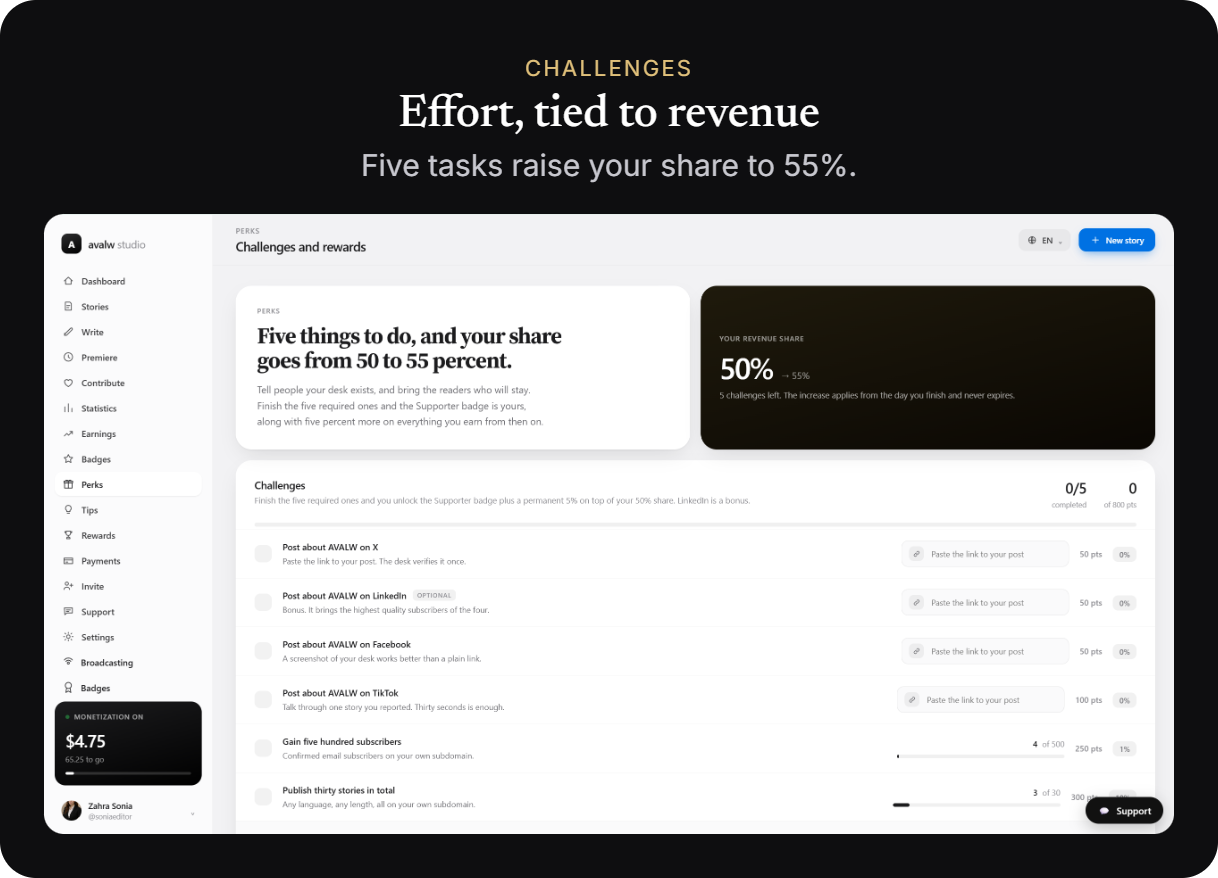
The challenges section ties effort directly and explicitly to financial outcome. By completing a clearly defined set of objectives, the share of revenue the user keeps rises from fifty to fifty-five percent, a permanent increase achieved through concrete actions. The objectives are not formal checkboxes but tasks oriented toward real growth: presenting one's own channel on the major social networks, each carrying a score, reaching a threshold of confirmed subscribers on one's own subdomain, and publishing a set number of articles. Each objective has a progress indicator, constantly offering a clear picture of the distance remaining to the next level and turning growth into a measurable path.
Editorial guidance
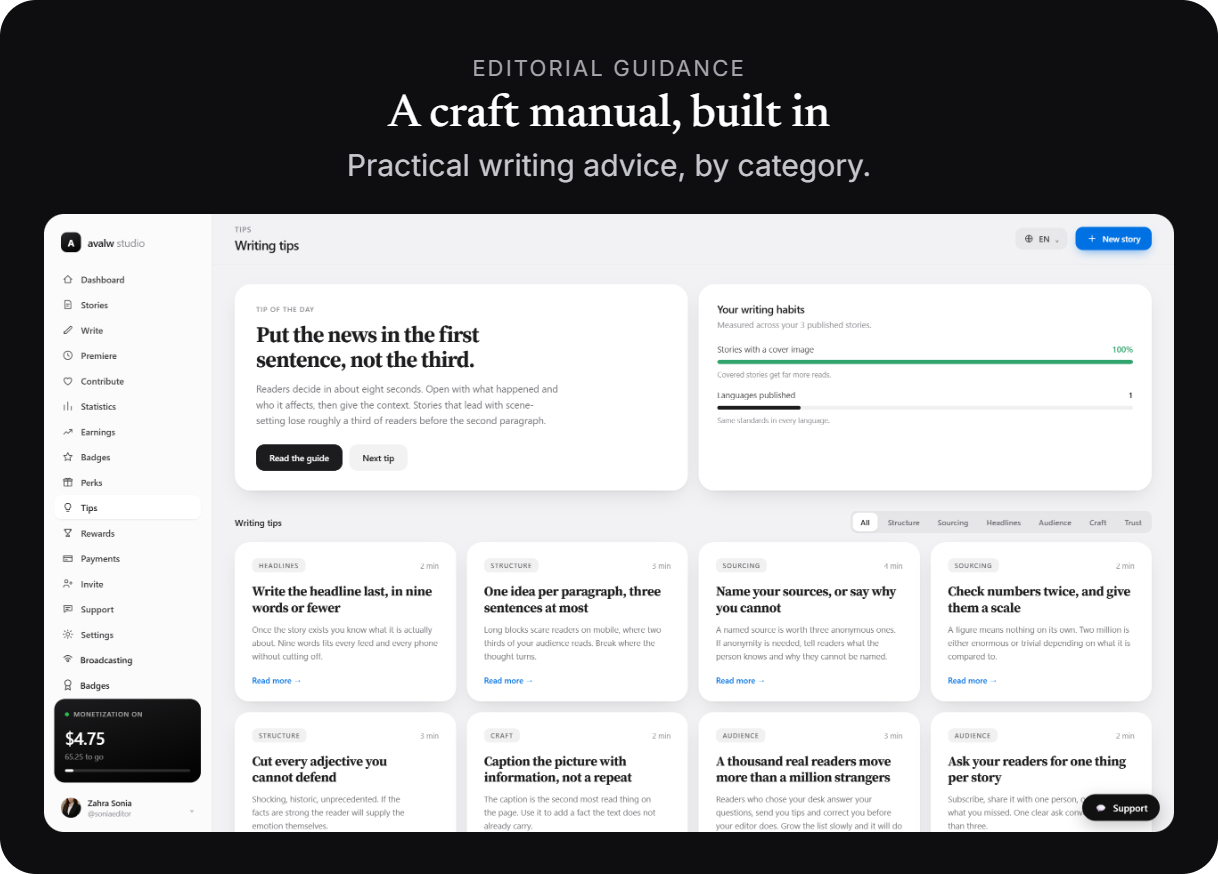
The platform also includes an editorial guidance section, in the form of practical writing recommendations that work as an integrated craft manual. Each recommendation is classified by category, from headlines and structure to sources and credibility, has an estimated reading time and links to a full guide. The advice is professional rather than generic: writing the headline only at the end, when the text reveals its true subject, in concise form; one idea per paragraph, adapted to mobile consumption where most readers are; naming sources or explicitly justifying anonymity; double-checking figures and giving them a scale that makes them meaningful; cutting any adjective that cannot be defended with facts. For a beginning creator these amount to a school; for a communication team, a style guide already built into the workflow.
Badges
The badges section records the recognitions earned along the way and turns them into markers of quality. Some are available from the start or unlock quickly, such as confirmation of the account's identity, publishing the first piece, activity in two or more languages, or retaining a high proportion of readers to the end of an article. Others remain deliberately locked, as clear objectives to pursue, among them an extensive history of reviews without a single error, priority on a story later picked up by other newsrooms, or consistency of publishing over a long period. Each badge implicitly defines what quality means on this platform and offers a concrete direction to follow.

Contribute
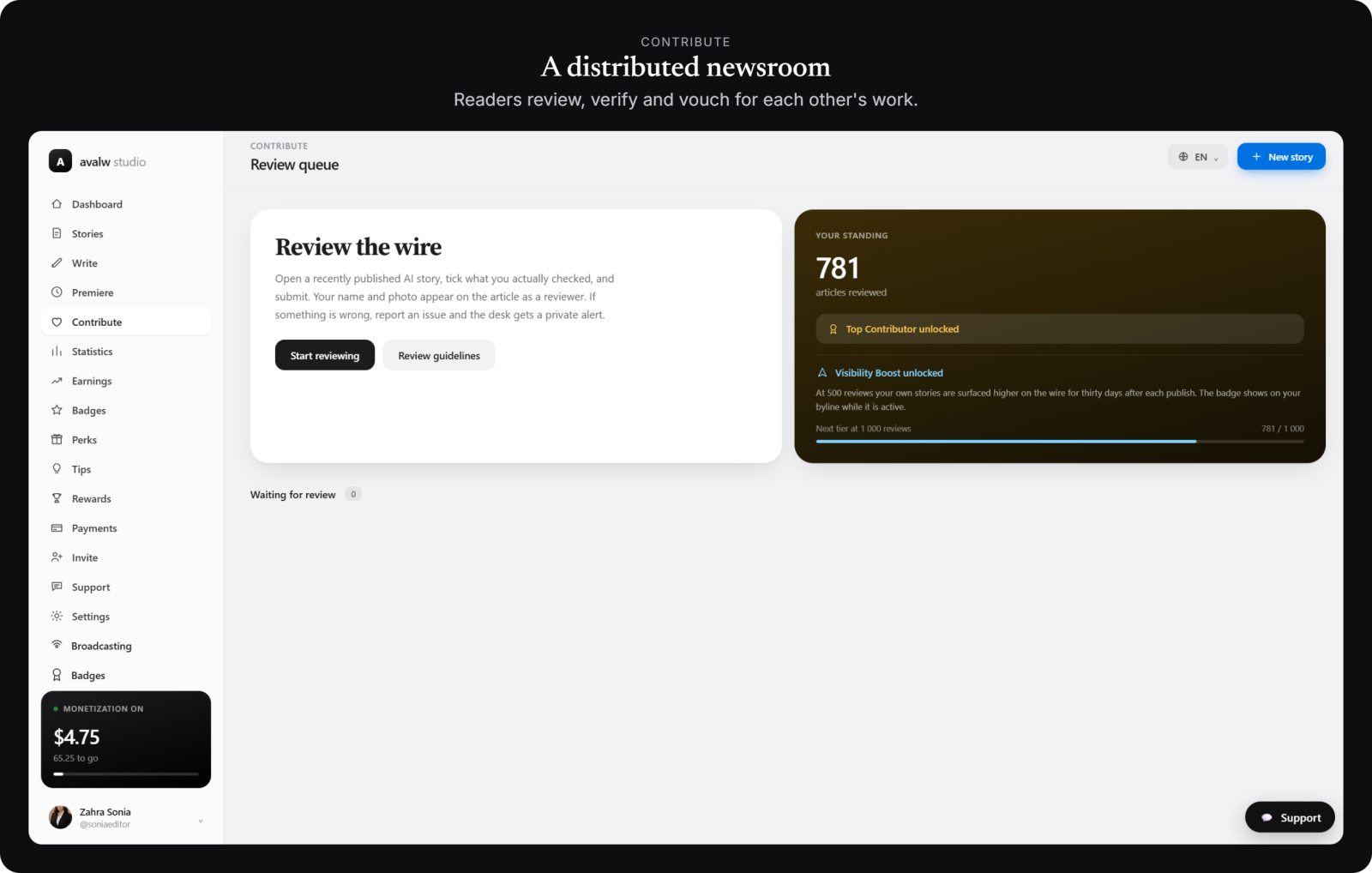
The contribution section integrates the user into a real editorial network beyond their own account. Here, pieces recently published by other members can be reviewed: facts, sources and images are checked, and the name and photograph of the person who performed the review appear associated with the article, as a mark of guarantee. If an error is identified, it can be reported, and the desk receives a private notification. The mechanism has a dual role, building reputation and creating a sense of belonging to a collective editorial process with clear thresholds for advancement, from top-contributor status granted after a certain number of accepted reviews to higher levels. It is, in essence, a distributed newsroom in which trust is built by verifying the work of others, exactly as in a serious press institution.
Rewards
The rewards section marks the most visible difference from the usual logic of platforms. Three thresholds are defined, and the associated rewards are not ephemeral digital distinctions but physical objects produced on the basis of the account's actual activity, with progress toward the first threshold displayed in real time as a percentage. On reaching a threshold of one hundred thousand subscribers, the account receives a printed volume gathering all published work in chronological order, from the first article to the one hundred thousandth reader, typeset and bound by hand in linen, with the name stamped on the spine, signed by the desk and numbered as a unique copy, printed nowhere else.
At the threshold of one million subscribers, the reward is a wall piece engraved with the most-read article, its cover image and the reader count, made in brushed metal and framed in walnut, ready to display, accompanied by promotion of the account across the network and invitations to the platform's events, with travel covered. At the threshold of ten million subscribers, the account receives a numbered trophy, cast in a very limited number of copies, together with a permanent place in the platform's gallery, a revenue share raised for life, a seat in the editorial structure and an annual award bearing the account's name, granted to a new creator. The principle behind the entire system is constant and, in its own way, elegant: the reward is not purchased and not granted artificially, but produced from the result of one's own work.

The reward is not purchased and not granted artificially, but produced from the result of one’s own work.
Payments
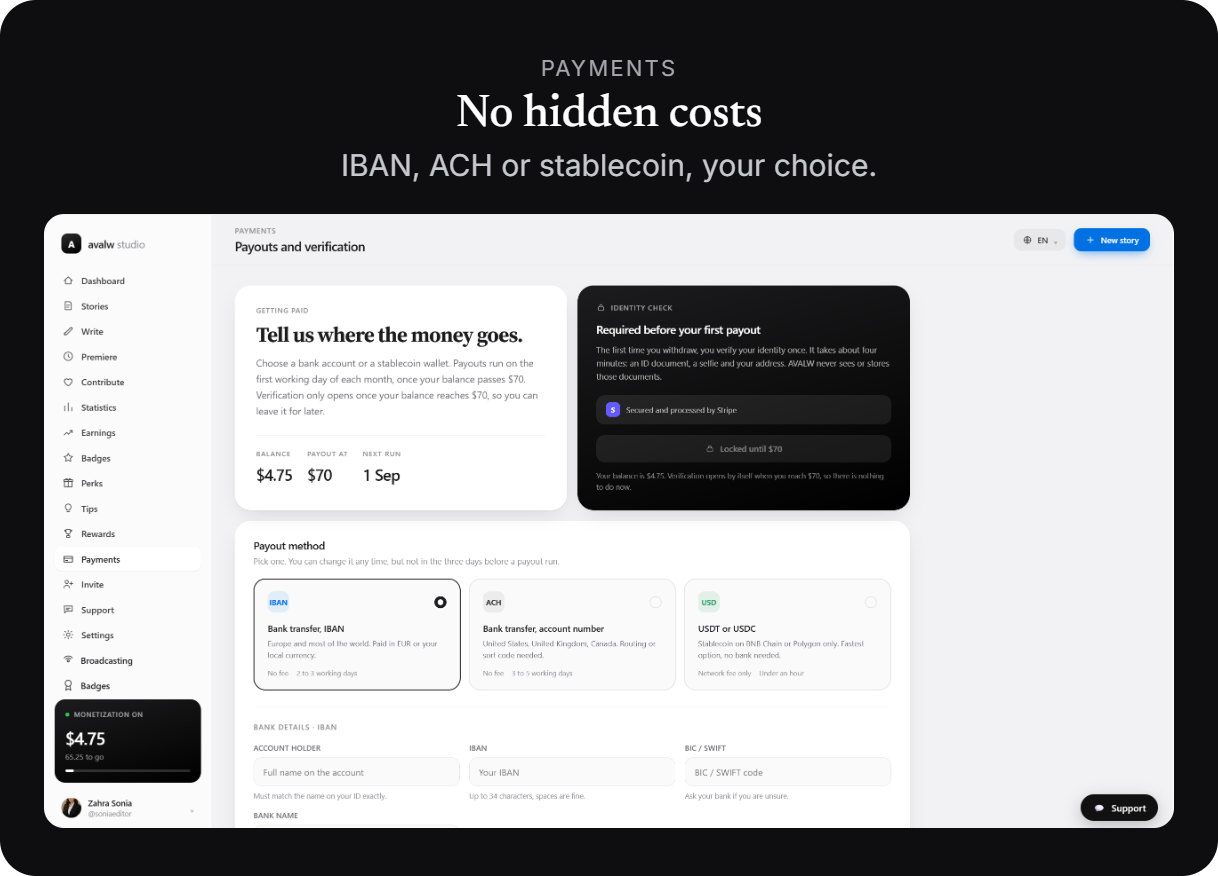
The payments section is built entirely around transparency, an element many platforms treat superficially. Three payout methods are available, each with explicit rules and no hidden costs: bank transfer via IBAN for Europe and most of the world, in euro or local currency, with no fee, in two to three working days; transfer by account number for the United States, the United Kingdom and Canada, also with no fee, in three to five working days; and payment in stablecoin on the supported networks, the fastest option, without banking intermediation, processed in under an hour. Clarity of payment terms is not a detail but an essential factor of trust and long-term retention.
Invite
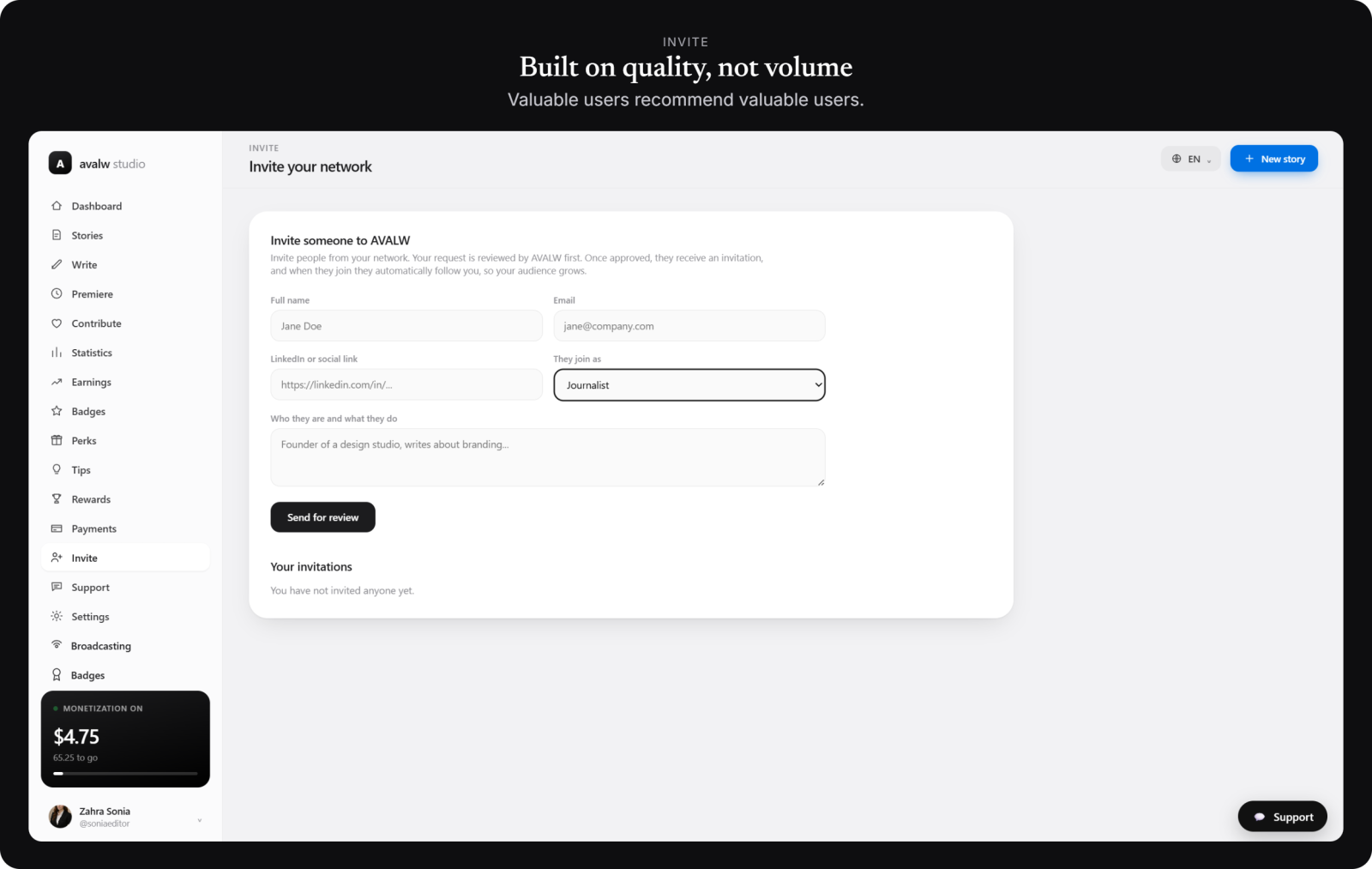
The invite section allows the network to be expanded directly from the panel by bringing in new collaborators, and reflects a simple principle: a platform grows in a healthy way when valuable users recommend other valuable users. Whether it concerns individual creators, journalists or teams within companies, the invitation mechanism reinforces the idea that the network is built on quality rather than volume.
A complete ecosystem, from day one
Taken together, all these components form a complete editorial ecosystem rather than a simple publishing platform. The user writes, measures their audience with serious tools, monetizes it through advertising and direct reader support, launches important pieces as events, raises their revenue share through concrete objectives, takes part in the editorial process of the entire network, and advances, step by step, toward tangible recognition. What matters is that all these tools are available before the audience is large, not offered as a later reward; the creator does not have to become important first in order to receive a professional's tools, but receives them from the start and grows with them.
This is, in essence, the proposition of AVALW Studio. It is not a space where someone is granted permission to write, but a complete media desk placed at the disposal of every account from the very first day, whether it belongs to an independent creator publishing their first article, a journalist with a career in full swing, or a company building its own independent and durable voice. The tools are already there, considered down to the last detail; the only remaining condition is for someone to step in and begin to use them.